Category: Know Your Rights

  • Collective Bargaining Basics: How Union Negotiated Impact Your Future

    Collective Bargaining Basics: How Union Negotiated Impact Your Future

    For school union employees, annual raises aren’t random — they are negotiated, structured, and legally protected. Unlike many private-sector jobs where pay increases are discretionary, union negotiated raises are built into collective bargaining agreements and salary schedules. But what do those raises really mean for your long-term financial future?

    This guide breaks down how union negotiated raises work, how they impact your lifetime earnings, and why they play a critical role in financial stability for public school employees.

    What Are Union Negotiated Raises?

    Union negotiated raises are salary increases secured through collective bargaining between employee unions and school districts. These raises are outlined in your district’s contract and typically fall into three categories:

    • Cost of Living Adjustments (COLA)
    • Step increases
    • Column (education) increases

    Organizations like the National Education Association and the American Federation of Teachers advocate at state and national levels, while local bargaining units negotiate specific district contracts.

    Unlike merit-based systems, these increases are transparent and predictable — which makes financial planning much easier.

    Types of Raises School Union Employees Receive

    Understanding the types of raises in your contract helps you see the full financial picture.

    1. Step Increases: Predictable Career Growth

    Most school districts use a step-and-column salary schedule. Each year of service typically moves you “one step” forward, increasing your pay automatically.

    Why Step Increases Matter

    • They reward experience.
    • They provide guaranteed annual growth (if funded in the contract).
    • They compound over time.

    For example, a $2,000 annual step increase doesn’t just affect one year — it increases every future paycheck moving forward. Over a 20–30 year career, that compounding effect can add tens of thousands (or more) to your total earnings.

    This predictability is one of the strongest financial advantages of unionized public employment.

    2. Cost of Living Adjustments (COLA)

    COLA raises are negotiated to help employees keep up with inflation. When inflation rises, unions negotiate increases to maintain purchasing power.

    Without COLA, inflation quietly reduces your real income. A 3% raise during a 3% inflation year maintains your financial position rather than growing it — but it protects you from falling behind.

    In states like California, COLA adjustments often align with state education funding formulas, which unions advocate to protect during negotiations.

    3. Column Movement: Investing in Education Pays Off

    Column increases occur when employees complete additional education — such as graduate credits, certifications, or advanced degrees.

    For certificated employees, moving from a Bachelor’s degree column to a Master’s degree column can significantly increase base salary. Over decades, that difference multiplies dramatically.

    This structure encourages:

    • Professional growth
    • Continuing education
    • Long-term career investment

    And importantly, these increases are permanent additions to your salary base.

    The Long-Term Financial Impact

    Compound Growth Over Time

    Even a 3–5% raise may not seem dramatic in a single year. But compounded over a full career, negotiated raises can add hundreds of thousands of dollars in total earnings.

    For example:

    • A 3% annual increase on a $60,000 salary adds $1,800 the first year.
    • But over 20 years, that consistent increase builds significantly larger cumulative income.

    This affects:

    • Your retirement contributions
    • Your pension calculations
    • Your Social Security earnings record
    • Your overall lifetime wealth

    Raises and Retirement Benefits

    For many school employees, retirement systems like California State Teachers’ Retirement System and California Public Employees’ Retirement System calculate pensions based on final compensation or highest earning years.

    Higher negotiated raises mean:

    • A larger “final compensation” number
    • Higher monthly pension payments
    • Greater financial stability after retirement

    Even small increases toward the end of your career can significantly impact your lifetime retirement income.

    The Power of Collective Bargaining

    Raises secured through collective bargaining represent more than just salary increases — they reflect collective advocacy.

    Through negotiation:

    • Salary schedules are adjusted.
    • Salary compression issues are addressed.
    • Equity between job classifications can be corrected.
    • Long-term financial fairness is pursued.

    Without organized representation, wage increases may depend entirely on district budget discretion, which can lead to inconsistent compensation growth.


    Inflation and Why Negotiated Raises Matter More Than Ever

    In recent years, inflation has affected housing, groceries, and healthcare costs nationwide. Without negotiated increases, employees effectively take a pay cut in real terms.

    Union advocacy ensures districts consider:

    • State funding increases
    • Budget surpluses
    • Enrollment changes
    • Cost-of-living data

    This protection helps employees maintain financial stability even during economic uncertainty.


    What You Can Do as a Union Member

    To maximize the financial benefits of negotiated raises:

    1. Understand your salary schedule. Know your step and column placement.
    2. Track your eligibility for movement. Don’t miss professional growth deadlines.
    3. Attend union meetings. Stay informed about negotiations.
    4. Review contract updates. Raises may include retroactive adjustments.
    5. Plan long-term. Factor guaranteed increases into retirement planning.

    Being informed allows you to fully benefit from what your union negotiates.


    Final Thoughts: Raises That Build a Future

    Union negotiated raises are not just yearly adjustments — they are building blocks for your financial future.

    Over time, structured increases:

    • Grow your total lifetime earnings
    • Strengthen your pension
    • Protect your purchasing power
    • Provide income predictability
    • Support long-term financial planning

    For school district employees, collective bargaining creates more than better working conditions — it creates financial security. Understanding how your negotiated raises work empowers you to make smarter decisions today that benefit you for decades to come.

  • Layoff Procedures

    Layoff Procedures

    A layoff is the temporary or permanent termination of employment by an employer for reasons unrelated to the employee’s performance. Losing your job is never welcome news. For most people, it’s a traumatic and frightening experience. Read your Calexico Unified School District CUSD/CSEA employment contract to help you stay informed.

    If you have been laid off, it means that your employer is experiencing financial hardship and is no longer able to pay you a salary. The recent outbreak of COVID-19 is the most recent example that forced businesses to downscale their workforce in order to survive.

    If your layoff is temporary, your employer may require you to return to work after a period of time. If your layoff is temporary, it means your employer may require you to return to work after a period of time. it makes no difference if your layoff is temporary or permanent. You will be unemployed and eligible for unemployment insurance or compensation.

    Reason for Layoff


    Employees may be laid off when companies aim to cut costs, due to a decline in demand for their products or services, seasonal closure, or during an economic downturn. According to the Calexico Unified School District CUSD employment contract. Here are the two main reasons for being laid off:

    • Layoff shall occur only for lack of work or lack of funds.
    • A limited-term employee may be laid off (separated/terminated) at the end of his/her assignment without regard to the procedures set forth in these rules.

    Notice of Layoff


    Upon the decision of the District to reduce the number of unit employees in the classified service of the District, written notice of layoff shall be sent by registered mail or delivered in person to the affected unit employee(s) by the Superintendent or his designee.

    The District shall send written notice of layoff to the affected unit employee(s) not less than sixty (60) calendar days prior to the effective date of layoff, informing the employee(s) of displacement rights, if any, and re-employment rights. Any notice of layoff shall specify the reason for layoff and identify by name and classification the employee(s) designated for layoff.

    When as a result of the expiration of a specially funded program, classification(s) are going to be eliminated at the end of the school year, and unit employee(s) will be subject to layoff for lack of funds, the employee(s) to be laid-off at the end of such year shall be given written notice on or before April 30th. If the termination date of any specially funded program is other than June 30th, such notice shall be given not less than sixty (60) calendar days prior to the effective date of the layoff.

    Nothing herein provided shall preclude a layoff for lack of funds in the event of an actual and existing financial inability to pay salaries of classified employees, no layoff for lack of work resulting from causes not foreseeable or preventable by the Board, without the notice required by subsections 2 and 3 hereof.

    Order of Layoff


    In considering the layoff of emergency, provisional, or limited-term employee(s) shall be laid off from any position while employees serving under restricted, emergency, provisional, or limited-term employment are retained in positions of the same class.

    The order of layoff of unit employees shall be determined by length of service. The employee who has been employed the shortest time in the affected class including time employed in a higher class if applicable shall be laid off first. Bumping rights of unit employee(s) shall apply after the determination of seniority in a class.

    Bargaining unit employees who are subject to layoff shall exercise bumping rights into any classification, within a current or previously held class, providing they meet minimum qualifications and providing that the classification in which they are bumping is equal or lower than the classification in which the employee has served. Reemployment shall be in the reverse order of layoff.

    • The “bumping” employee must have seniority over the last person to be hired in his/her class. The “bumping” employee shall “bump” the least senior employee in his/her class with the most hours. A lack of seniority in his/her present class will permit him/her to “bump” the least senior employee with the most hours in the succeeding lower classes to determine if he/she has more seniority. Failing to have seniority over the last hired in any of the succeeding lower classes in the same series, the “bumping” employee may then look to other classes where he/she has established permanency. Transferring seniority from one class series to another or from one unrelated class to another is not allowed.
    • The “bumping” employee shall consult the Personnel Commission Office (“P.C. Office”) regarding proper procedures and the seniority standing of any employees who may be affected by the bumping procedure. The seniority standing of “bumping” and “bumped” and other employees in the class shall be determined on the seniority lists maintained by the P.C. Office.
    • The P.C. Office shall provide the Superintendent with the name of the employee to be “bumped”.
    • The Superintendent shall send a layoff notice to the “bumped” employee.
    • The employee being “bumped” has the same seniority “bumping” rights and may exercise them in accordance with these rules as though he/she was being laid off.

    In case of two (2) or more unit employees having the same length of service, the order of layoff of such employees shall be determined by lot. The employees affected shall be invited to the drawing and a CSEA and District representative shall be present.

    Any employees going to a lower class pursuant to this rule shall receive the maximum of the salary range of the lower class provided that such salary is not greater than the salary received in the higher position.

    In all cases where an employee elects to exercise his/her seniority rights and move to a lower class in lieu of layoff, his/her name shall be placed on a layoff list for the position from which he/she moved.

    For purposes of this section, for service commencing or continuing after July 1, 1971,
    “length of service” means all hours in a paid status, whether during the school year, a holiday recess, or during any period that a school is in session or closed, but does not include any hours compensated solely on an overtime basis. For employees in the classified service hired prior to July 1, 1971, the date of employment in the regular classified service (regardless of hours worked per day or months per year, a day is a day and a year is a year) shall be used to determine the length of service prior to July 1, 1971. Seniority within a class shall be calculated by time worked within classifications of higher, equal, or lower ranking in which the employee is serving or has served.

    “Hours in Paid Status” shall not be interpreted to mean any service performed prior to entering into probationary or permanent status in the classified service of the District except where the affected unit member was employed as a substitute in the assignment received upon entering into probationary status, and in restricted positions as provided in the Education Code (Section 45105). For purposes of this section, the word “class” shall be defined as a group of positions (classifications) within a job occupational family which have common characteristics and are ranked according to a job family. The word “classification” shall be defined as a position within a class that has a designated title, specific duties, responsibilities, and minimum qualifications, and which has a designated salary range established for each position within a class.

    Demotion or Retirement in Lieu of Layoff


    A unit employee subject to layoff may, in lieu of such layoff, if qualified and subject to the provisions of this section, elect to be demoted to a lower job class, voluntarily reduce their assigned time if this option is made available or retire under the provisions of the California Public Employees Retirement System (PERS). The right to elect demotion shall not apply to restricted classified employees.

    To be considered for demotion in lieu of layoff, which demotion would result in the
    displacement of a unit employee with less length of service subject to the provisions of this Article, the unit employee shall be required to notify the Personnel Office in writing of such election not later than five (5) work days after receiving the notice of layoff.

    A unit employee displaced under Section C of this Article shall be subject to layoff
    according to the provisions of this Article.

    A unit employee who elects demotion or retirement in lieu of layoff shall nonetheless be placed on the thirty-nine (39) month re-employment list and shall be eligible, when a classified vacancy occurs, to return to the former job class in the order of service as any other employee on such list.

    Employee(s) who elect to take demotion shall be extended for an additional twenty-four (24) months provided that the same tests of fitness under which they qualified for appointment to the class shall still apply. (Education Code Section 45298).

    Re-employment Procedures


    A unit employee who is laid off shall be placed on a thirty-nine (39) month re-
    employment list and shall be re-employed in preference to new applicants. The employee shall be required to maintain his/her current address on file with the P.C. Office.

    If, during a unit employee’s eligibility period for re-employment, a classification becomes vacant, the Personnel Commission Director shall send written notice by registered mail or telegram to the last known address of such unit employee(s) offering re-employment in order of service, providing such employee meets the minimum qualifications required of the classification.

    A unit employee who receives such notice of re-employment and refuses to accept in writing the offer of re-employment within ten (10) working days shall be deemed to have rejected the offer of re-employment.

    If the unit employee in a layoff status accepts the classification being offered, the unit employee shall have up to thirty (30) calendar days from the postmark date of the notice to report for work. This does not preclude a unit employee from returning to work in fewer than thirty (30) calendar days.

    A unit employee re-employed after being laid off shall be fully restored to his/her class with all rights to permanent status. Service credit and benefits shall not accrue during the period of layoff.

    Refusal of an offer of provisional or limited-term employment shall not affect the
    standing of any employee on a layoff list.

    Employees on layoff lists shall be eligible to compete in promotional examinations for which they qualify.

    Names shall be certified for appointment from employment lists as follows:

    • Layoff the Re-employment list (one name) until the list is exhausted.
    • Promotional Eligibility List – When a qualified candidate exists within the employee ranks, he/she shall be first interviewed. If no suitable candidate is selected from the promotional list, the process continues with the Open Eligibility List.
    • Open Eligibility List (top three ranks)

    Seniority List


    The list shall consist of permanently classified employees listed in order of seniority (see Order of Layoff), and by class series and classification. The most senior employee is to be listed first.

    In the computation of seniority, all served within a class plus higher classes within the same class series shall count as seniority within the class. Continuous or uninterrupted service as a probationary or permanent employee within a class, rather than actual days worked, shall determine seniority.

    The P.C. Office shall establish and maintain the seniority lists for all class series. These lists are to be updated from year to year to insure their accuracy and availability to the Board.

    At least twenty (20) working days prior to the effective date of a layoff, the District will provide CSEA with a seniority roster.

    Volunteer Aides


    No district may abolish any of its classified positions and utilize volunteer aides, as authorized by Education Code Section 44814, 44815, 35212, and Labor Code Section 3364.5, in lieu of classified employees who are laid off as a result of the abolishment of a position; nor may a district refuses to employ a person in a vacant classified position and use volunteer aides in lieu thereof.

    It is the intent of the Legislature to permit school districts to use volunteer aides to enhance their educational program but not permit displacement of classified employees or to allow districts to utilize volunteers in lieu of normal employee requirements.

    Limited Term Employees


    In the event of a layoff of permanent classified employees, no limited-term employee shall be retained to render service that a laid-off classified employee is qualified to render.

    Employee Severance Provisions


    Bargaining unit employees laid off due to lack of work or funds shall continue to have the District pay for health and welfare benefits for three (3) months following a layoff. Should the employee obtain other employment that offers health and
    welfare benefits during the three-month period, the employee shall advise the District so that the benefits may be terminated.

    In lieu of layoff, the employee may exercise their early retirement benefit rights under Article VI of the collective bargaining agreement.

    In Conclusion


    Being laid off from your job is one of life’s major high-stress events, but there are steps you can take to make the transition a little less rocky. Read your Calexico Unified School District CUSD employment contract to help you stay informed.

    Make sure you have some savings, keep your résumé up to date, and reach out to your contacts. Remember that a layoff is a great excuse to take stock of your life and go after what you’re most passionate about.


    Additional Resources

  • The Brown Act: Ensuring Open Public Meetings in California

    The Brown Act: Ensuring Open Public Meetings in California

    The Ralph M. Brown Act is California’s key “sunshine law” designed to make local government decision-making open and accessible. For employees represented by the California School Employees Association (CSEA) working at public school districts, understanding the Brown Act helps ensure your voice and rights are protected in the governing process.

    What Is the Brown Act?

    Enacted in 1953, the Brown Act guarantees that meetings of local government bodies—including school boards—are open to the public except in very limited circumstances. The law applies to:

    • School district boards of education
    • District committees and commissions
    • Other local legislative bodies

    Why Does It Matter to CSEA Employees?

    • Transparency: You have the right to know what your school board is discussing, deciding, and planning—especially on topics that impact working conditions, staffing, wages, and district policy.
    • Participation: CSEA members can attend, observe, and offer public comment. Your presence can influence board decisions that directly affect your workplace.
    • Accountability: When meetings are open, decisions can’t be made “behind closed doors” without public input.

    Key Requirements for School Boards

    1. Open Meetings

    All discussions, deliberations, and actions by the school board must be held publicly unless an exception applies.

    2. Notice and Agendas

    • Meeting agendas must be posted in a publicly accessible place at least 72 hours before a regular meeting.
    • The agenda must list topics to be discussed or acted upon.

    3. Public Comment

    • CSEA employees and the public must be allowed to comment on any item on the agenda and, within limits, on items not on the agenda.
    • Boards can set reasonable time limits for speakers but cannot prohibit comments.

    4. Accessible Locations

    • Meetings must be held in places that are accessible to all community members, including those with disabilities.

    5. Closed Sessions

    These are exceptions, permitted only for specific subjects like personnel matters, pending litigation, or labor negotiations. The board must announce (in general terms) the topic before entering a closed session and report any final decisions afterward.

    Brown Act and Labor Relations

    CSEA employees, as district staff and union members, are often impacted by:

    • Contract negotiations
    • Staffing decisions
    • Changes in district policy or budget

    These issues will appear as agenda items and may also involve closed (confidential) sessions. While labor talks may occur confidentially, the broader process, including approval of agreements, must be public.

    Common Questions

    Can I be required to register my name to attend?
    No—everyone has the right to attend anonymously.

    Can the board vote in secret on issues like layoffs or salary?
    No final actions must be taken in public, and the votes of individual members must be recorded.

    What if the Brown Act is violated?
    Complaints can be filed, and courts may nullify actions taken unlawfully.

    Tips for CSEA Members

    • Review published agendas for items affecting your job.
    • Attend open board meetings—your presence matters.
    • Use the public comment period to share concerns or support.
    • Ask your CSEA representative about how the Brown Act applies during contract negotiations and grievance processes.

    Conclusion

    The Brown Act exists to ensure openness, fairness, and accountability in the way California school districts are governed. By knowing and using your rights under the Brown Act, CSEA employees help protect transparent decision-making in schools, supporting a stronger voice for all district staff.

  • Classified Salary Schedule

    Classified Salary Schedule

    A classified salary schedule is a structured pay system used by Calexico Unified School District that outlines the salary and compensation levels for employees in classified positions, such as administrative assistants, custodians cafeteria workers, IT employees, or maintenance workers.

    By having a clear and transparent salary schedule, employees in classified positions can understand how their compensation is determined and can negotiate for better pay and benefits.

  • Parental Leave Benefits

    Parental Leave Benefits

    Having a child is one of the biggest events to happen in an employee’s life. Both employees and their children can benefit from time together to bond, especially in the first few months of life. However, for many employees, taking an extended period of time off is unrealistic if they have to worry about finances and the possibility of losing their jobs.

    Recognizing this, California has led the charge to ease this burden for new parents bypassing some of the most protective leave laws in the nation. Although paid maternity leave is often framed as an issue that matters only to working women, paid paternity leave or bonding leave is also available for fathers who need bonding time with their newborn child.

    What Is Bonding Leave?


    Parental leave, also called “bonding leave,” is the time off that parents take to bond with their new child. For women in California, maternity leave is a combination of parental leave and pregnancy disability leave (see below for an explanation). For men in California, paternity leave is the equivalent of parental leave.

    The federal Family Medical Leave Act (FMLA), and the similar California Family Rights Act (CFRA), require employers with 50 or more employees to provide up to 12 weeks of unpaid leave to bond with a new child. The New Parents Leave Act (NPLA) provides for the same amount of leave for new parents who work for employers with 20 to 49 employees. Below are the most common reasons for taking advantage of the FMLA right:

    • For the birth and care of the newborn child of an employee;
    • For placement with the employee of a child for adoption or foster care;
    • To care for an immediate family member (i.e., spouse, child, or parent) with a serious health condition; or
    • To take medical leave when the employee is unable to work because of a serious health condition.

    Paid Parental/Child Bonding Leave


    As provided by Education Code section 45196.1, employees shall be entitled to parental leave as set forth in this section. For purposes of this section, “parental leave” shall be defined as leave for reason of the birth of the employee’s child, or the placement of a child with the employee for adoption or foster care.

    • Employees shall be entitled to use all current and accumulated sick leaves for parental leave, for a period of up to twelve (12) workweeks.
    • When an employee has exhausted all current and accumulated sick leave and continues to be absent on account of parental (child bonding) leave under the California Family Rights Act (CFRA; Government Code section 12945.2), he/she shall be entitled to 50% pay for any of the remaining twelve (12) workweek period. Such 50% payment shall be paid as set forth in section C (Entitlement to Other Sick Leave) above but shall not count against the leave entitlement set forth in that section. In order to use 50% pay, the employee must be eligible for leave under the CFRA, except that he/she is not required to have worked 1,250 hours in the twelve (12) months immediately preceding the leave.
    • Any leave taken under this section shall count against any entitlement to child bonding leave under the CFRA and the aggregate amount of leave taken under this section and CFRA shall not exceed twelve (12) workweeks in any twelve (12) month period.
    • Employees shall not be entitled to more than one (1) twelve (12) week period for parental leave in any twelve (12) month period.
    • Unit members shall give thirty (30) calendar days’ notice of parental leave. Parental leave under this section shall be taken in increments of at least two (2) weeks’ duration, except on two (2) occasions leave can be of shorter duration.

    In Conclusion


    Maternity, Paternity, and Adoption leave, more commonly referred to as “Parental Leave,” is leave associated with the birth of an employee’s own child or the placement of a child with the employee in connection with adoption or foster care. A variety of leave programs are available to Calexico Unified School District employees. Get informed and take enjoy the benefits of your employment rights.

    Read the Pregnancy Disability Leave article if you or your spouse need more information about our pregnancy disability rights.

  • Prevent Workplace Harassment

    Prevent Workplace Harassment

    Workplace harassment is an all too common problem in today’s society that can have serious and long-lasting impacts on both employees and employers. No matter the size of the business or the industry, it is important for employers to take steps to ensure that their employees feel safe and respected in the workplace.

    It can range from subtle forms of discrimination to physical or verbal abuse and can have a huge impact on employee morale and productivity. It is also unlawful for an employer to permit a hostile work environment for employees due to their race, religion, ethnicity, disability, or another protected status.

    Unlawful sexual harassment in the workplace is either (1) “quid pro quo” harassment (pressure on an employee to engage in sexual behavior in order to stay employed or as the basis for employment decisions such as promotion), or (2) a hostile work environment, where adverse comments or actions are so severe or pervasive as to create an unreasonably uncomfortable environment and are either explicitly sexual or motivated by the victim’s sex.

    How do you know if someone is harassing you at work?


    Ordinary work criticism does not amount to unlawful harassment unless it is motivated by the target’s sex, race, age, etc. AND is so extreme or repeated that a reasonable person would find them so offensive as to fundamentally alter working conditions.

    Hostile environment harassment can take many forms, including:

    • sexist remarks regarding an employee’s body, clothing, or sexual activity, or reflecting disrespect for all females (or males);
    • constant leering or ogling;
    • offensive touching, patting, pinching, or invasion of personal space;
    • postings of nude or scantily-clad persons
    • Comments, requests, and demands.
    • Continuing to talk to someone after they have asked to be left alone.
    • Flashing.
    • Following or stalking.

    What to Do if you Believe you have been Harassed at Work


    There are several things classified employees should do if they are
    being unlawfully harassed, including:


    1. Act quickly – The best defense against harassment is a strong offense. Confront the harasser. Tell him/her that his/her behavior is offensive, and ask him/her to stop.
    2. Document it – Save offensive emails and texts. Keep a diary where entries are in ink and dated. This avoids any allegation later that these entries were created long after the fact.
    3. Get support from co-workers – Make sure co-workers are aware of harassment situations and efforts being made to remedy them.
    4. File a grievance – If the collective bargaining agreement contains language prohibiting sexual harassment, utilize the grievance procedure to resolve the problem. In addition, review the employer’s written policy on sexual harassment.
    5. Notify the employer – regardless of whether your harasser is a supervisor or co-worker. If the employer is not notified, it is not liable for harassment by co-workers (only supervisors). Put it in writing, and keep a copy.
    6. Find other victims – If evidence can be found to show that the harasser has abused other workers, or that the harassment has been condoned by management, your harassment claim will be strengthened.

    Note: The laws governing discrimination are extensive. If a classified employee feels he/she might have been the victim of a discriminatory practice, he/she should contact his/her CSEA Labor Relations Representative, or the federal or state agency to determine what actions are appropriate.

    *Classified Employees Cannot Be Sexually Harassed or Harassed Based on
    Another Protected Status

    • Source: Title VII of the Civil Rights Act of 1964 (42 USC § 2000e)
    • Source: Fair Employment and Housing Act (Cal. Govt. Code § 12940)
    • Source: Cal. Education Code Sections 212.5, 230, 231.5

    In Conclusion


    Employees at CUSD should be aware of the policy and how to identify and address potential incidents. Employers should also take steps to create a culture of respect in the workplace. This can be done by encouraging open dialogue, promoting diversity and inclusion, and providing employees

    As you can see, Workplace harassment is an all too common problem in today’s society that can have serious and long-lasting impacts on both employees and employers. This article is just to show you an overview of the rights and tools that we as CSEA employees can utilize to fight for your rights.

  • Retirement Benefits

    Retirement Benefits

    Do you want to know when you are eligible to retire? Are you wondering what formulas are used to calculate your retirement benefit? These are among the most common questions classified employees ask.

    As an employee of Calexico Unified School District, you are part of the CalPERS retirement program. The California Public Employees’ Retirement System (CalPERS) is an agency in the California executive branch that manages pension and health benefits for more than 1.5 million California public employees.

    Your retirement benefit is based on a retirement formula using the following criteria:

    • Total service credit
    • Age at retirement
    • Highest average annual compensation (12-month or 36-month consecutive period)

    You may have more than one retirement formula based on your membership date, your membership category, and your employer’s contract with CalPERS.

    Eligibility Requirements for Retirement


    Your minimum retirement age depends on your retirement formula:
    *50, 52, or 55 Note: If you have a combination of classic and PEPRA service, you may be eligible to retire at age 50

    The minimum service requirement is five years, or 10 years if you are a State of California Second Tier member There are exceptions to the minimum service requirement:

    • You’ve worked at least five calendar years as a permanent part-time employee (Government Code section 20970)
    • You’ve established reciprocity with another California public retirement system Refer to the publication A Guide to CalPERS When You Change Retirement Systems (PUB 16)

    Basic Retirement Calculation


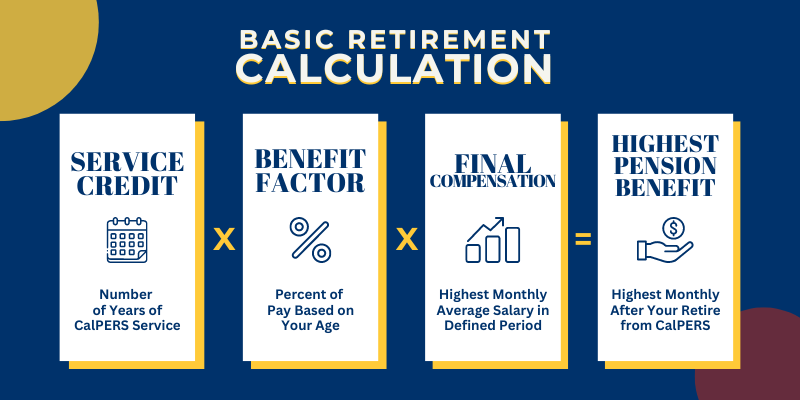
    The key to calculating your retirement benefit is to understand how service credit, age, and final compensation are used in the basic retirement calculation Increase any one of these factors and you’ll increase your overall benefit. The basic retirement calculation is shown below:

    Basic Retirement Calculation

    Service Credit

    Service credit is earned on a fiscal year basis, which is July 1 through June 30. If you are paid every month, 10 months of full-time employment will equal one year.

    You cannot earn more than one year of service credit in one fiscal year. If you work less than eight hours per day, it will take you longer to earn a year of service credit.

    Check the pdf file below to see a cheatsheet charts PDF file. It contains two charts that show the benefit factor increases and the percentage of final compensation you will receive.

    Benefit Factor

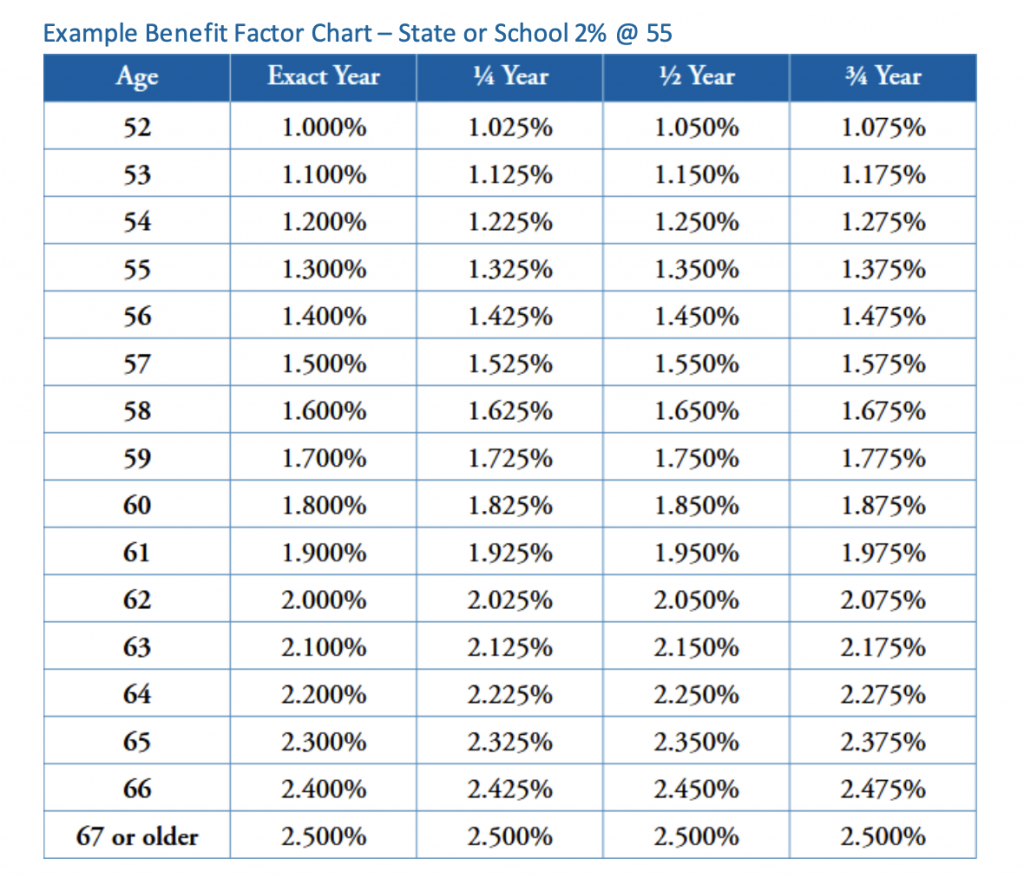
    Your benefit factor, also known as the “age factor,” is the percentage of pay you’ll receive for each year of service credit earned. It is determined by your retirement formula and age at retirement.

    Starting at your minimum retirement age, your benefit factor increases every quarter year up to a maximum age. For example, if your retirement formula is 2% at 55 and you retire at age 55, you will get 2% for each year of service credit. The percentage increases every quarter after age 55 up to the maximum age of 63.

    View Benefit Factor Charts Online


    Go to www.calpers.ca.gov/benefitcharts to find the retirement formula charts for your benefit factor and final compensation

    Benefit Factor Chart

    Retirement Planning Checklist


    As you plan for your retirement and get ready to submit your retirement
    application, use the following checklist as a reminder of what you need to
    consider You can find a detailed checklist with links to all our retirement
    planning resources at www.calpers.ca.gov/retirementchecklist

    In Conclusion


    As you can see, retirement planning might sound scary. Make sure you talk to your CSEA representative and ask for advice on the process. This article is just to show you an overview of the rights and tools that we as CSEA employees can utilize to fight for your rights.

  • Vacation Benefits

    Vacation Benefits

    Here is everything you need to know about your vacation benefits. You can find more information in the Calexico Unified School District’s Employee contract. (ARTICLE XIV).

    *One (1) month before the end of school or the end of the fiscal year (whichever comes first) the District will provide all employees with vacation balances in order to be in compliance with the maximum allowable carryover vacation days.

    Vacation Time-Off Rules


    1. Every employee in a permanent, probationary, restricted status or a permanent employee temporarily assigned to a provisional position shall earn vacation at the prescribed rate as part of his/ her compensation. Vacation shall be earned during a paid leave of absence.
    2. Earned vacation shall not become a vested right until the completion of the initial six months of employment.
    3. Classified employees who are employed on an hourly basis shall earn vacation at the ratio of their hours worked bear to eight (8) hours per day, forty (40) hours per week, weeks per month, or months to a calendar year.
    4. Employees with more than six (6) months of service who, either voluntarily or
      involuntarily discontinued their employment with the District, shall be entitled to the unused vacation time they have earned and shall be granted vacation pay. Employees who terminate with less than six (6) months of service shall not be entitled to vacation pay.
    5. Employees working less than a 12-month calendar will take their vacation during the winter and spring vacation periods consistent with the needs of the District. The remaining annual vacation leave shall be used during the year in which it is earned. In the event that vacation cannot be taken or is not granted by the employee’s supervisor, vacation days may be paid out at the end of the fiscal year in which they were earned. Vacation days in excess of the days that were paid out may be carried over for use in the following year. Employees working less than a 12-month calendar may accrue a maximum total of ten (10) vacation days. Prior to retirement, all vacations shall be used.
    6. Employees may have their vacation split, but no employee will be denied at least two weeks of his/her vacation to run consecutively during the prime time. Said prime time will be considered to be from March 1st through October 31st. This is not taken to mean that an employee will not be granted his/her full vacation at one time, provided the administration can see fit to approve it during the prime time.
    7. Vacation time shall be used during the year that it is earned. Vacation may, with the approval of the supervisor, be taken at any time during the school year. In the event that vacation cannot be taken or is not granted by the employee’s supervisor, a maximum of fifteen (15) days may be carried over for use in the next year. Prior to retirement, all vacation leave shall be used.
    8. Authorized paid holidays to occur in the period in which an employee is on paid vacation shall not be counted as vacation time. A period of illness occurring during a vacation period may not be construed as sick leave except as follows: Any employee may interrupt or terminate vacation leave in order to begin sick leave without returning to active service, provided, the employee notifies his/her supervisor within twenty-four (24) hours and subsequently provides a statement from his/her attending physician attesting to the illness and its duration.
    9. Vacation schedules shall be prepared by the administration with due regard to sections 6 and 7. Efforts shall be made to enable vacation to be taken at times convenient to the employee, consistent with the needs of the service and the workload of the department, with preference being given in seniority order.
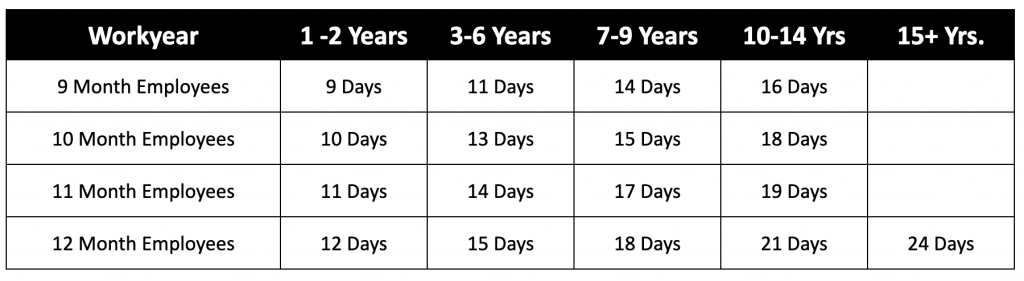
    10. Unit members shall earn vacation on the following basis:
    Calexico Unified School District Vacation Hours

    In Conclusion


    As you can see, there are many rules for vacation time. This article is just to show you an overview of the rights and tools that we as CSEA employees can utilize to fight for your rights. Take a moment to review your contract.

  • Professional Growth

    Professional Growth

    Are you interested in earning an additional 5% on your monthly paycheck? Are you planning to go back to school? All employees at Calexico Unified School District can apply for additional compensation.

    This additional compensation is an award earned by a classified employee who successfully completes ten (10) semester units or the equivalent in academic courses. Course obtained must pertain to the employee’s specific classification or area of employment.

    Classified Professional Growth Committee:


    The Professional Growth Committee consists of:

    • No more than five (5) full-time district employees.
    • Four (4) members shall be from the Classified Service, appointed by the CSEA Chapter
    • One (1) from the Administrative staff, appointed by the Superintendent.

    Duties of the Committee


    • Prepare a course list for recommendation to the Superintendent containing representative courses for each classification of employees or groups of employees, such a list is not to be exclusive, but to serve as examples and guides only.
    • Place unit values on all approved courses.
    • Recommend additional or revised policy to the Superintendent for Board adoption as necessary (i.e., how many units of approved coursework constitute additional compensation increment, etc.)

    Qualification for the Award


    • An additional compensation Award may be earned by a classified employee who successfully completes ten (10) semester units or the equivalent in academic courses taken in colleges, junior colleges, adult education, or other approved educational experiences such as attendance at institutes, lectures, workshops, seminars, or conferences sponsored by educational or professional associations. Course obtained must pertain to the employee’s specific classification or area of employment.
    • Credit may be granted for courses not on the approved list when evidence that benefit will accrue to the District is shown (example: course outline) and when approved by the employee’s supervisor, the Director of Personnel, and the Superintendent (prior approval required prior enrollment).
    • An employee who wishes to appeal his supervisor’s ruling with respect to the employee’s submission of individual research plans, or proposed courses for credit, and who wishes to have the matter reviewed in a hearing of the Professional Growth Committee, must present such request in writing to the Chairman of the Professional Growth Committee.
    • Of the ten units required, not less than seven must relate to the employee’s specific classification or area of employment in the District. (All ten units may be in that area.)
    • Credit may be granted only for courses successfully completed after July 1, 1970, during the first year of the program. After the first year of the program retroactive recognition is set at six (6) years and initiative and academic credits become outdated if not used within six (6) years.
    • Participation in educational conventions, institutes, and conferences may be considered a part of this project. Credit will be allowed for participation if the District does not reimburse the participant for 51% or more of actual and necessary expenses, including mileage. A total contribution of ten- (10) hours of actual participation is required for one (1) growth point.
    • No one shall receive credit for institutions, lectures, or conventions if these are attended during the working day and/or if the employee is being paid for other services at the same time without the prior approval of the Board of Trustees.
    • Education required at the time of employment for the position may not count toward professional growth, except for promotional purposes.
    • Incumbents in positions whose job specifications now require more educational training than that required at the time of employment shall be allowed credit for units that would have counted toward the requirement.
    • One unit (or one semester hour) normally represents one hour per week during one semester in lecture or recitation work with necessary preparation time, or three hours per week in the laboratory or other work not requiring homework or other preparation.
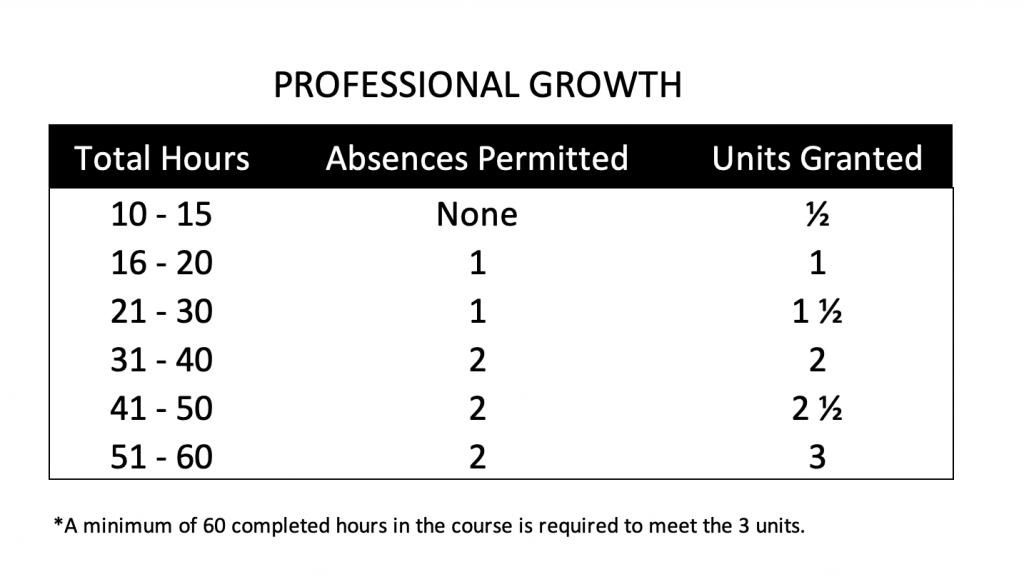
    • Credit for classes in adult education or other approved educational experiences will be equated as follows:
    Professional Growth Table
    • Professional Growth will be capped at a maximum of 20%; Current employees can apply for two (2) additional awards of 5%, not to exceed 20%; New employees hired after July 1, 1999, can apply for one award of 5%. Thereafter they can apply for a one-time bonus of 5%.
    • At least two (2) years must elapse before an additional increment may be granted.
    • It is the responsibility of the employee to apply to the District Administration by May 1st that he/she will qualify for an award of additional compensation beginning the following July 1st. The 5% compensation shall become effective on the next July 1st, upon presentation of evidence of a grade of ‘C’ or better on completion of courses. (10 units)
    • It is the responsibility of the employee to apply to the District Administration for credit for courses taken and to present evidence of successful completion of courses.
    • Attachment A, List of Approved Courses, is a representative list of courses currently offered at nearby colleges, private institutions, the Regional Occupations Program, and adult education courses at high schools. The Classified Professional Growth Program Committee will revise the list.
    • Upon the promotion of a Classified employee to a higher range, his/her professional growth program will commence without carryover of credits earned on the previous range.
    • Limit course selection to 9 units per subject area.


    Click on the links below to obtain more information about the CUSD Professional Growth program and how to submit your application.