
Author: vhs

  • CSEA Chapter 399 Scholarships

    CSEA Chapter 399 Scholarships

    $200 Senior Scholarships


    The $200 Senior Scholarship is a one-time scholarship for children of CSEA Local Chapter #399 Members in Good Standing who will be graduating from high school this 2023 year and would like to further their education by attending a Community College, 4-Year College, or Trade School.  He/She must have a minimum GPA of 2.0 to qualify and must submit proof of enrollment into the school they will be attending along with the application.

    $500 Frances Felix Scholarship


    The $500 Frances Felix Scholarship is a one-time scholarship for the children of CSEA Local Chapter #399 Members or Members themselves who would like to further their education by attending a Community College or 4-Year College.  He/She must have a minimum GPA of 2.0 and a “C” average.  An unofficial transcript must show enrollment of a minimum of 9 units/credits in order to qualify.  In addition, a 250-400 word essay entitled “What an Education Means to Me” must be submitted with the application.

    $500 Perpetual Scholarship


    The $500 Perpetual Scholarship is a one-time scholarship for CSEA Local Chapter #399 Members who would like to further their education by attending a Community College or 4-Year College.  He/She must have a minimum GPA of 2.0 and a “B” average.  An unofficial transcript must show enrollment of a minimum of 9 units/credits in order to qualify.  In addition, a 250-400 word essay entitled “What an Education Means to Me” must be submitted with the application

    • Applications are attached and are also available through your Scholarship Committee members:  Krystle Casares [email protected], Esperanza Amial [email protected], Lorena Gastelum  [email protected]
    • They will also be made available through the Calexico High School website.  
    • If you have any questions, please feel free to contact any Committee Member.
    • Be aware that CSEA has other Scholarship opportunities, please log onto csea.com for more Scholarship opportunities.
    • Recipients of Scholarships will be notified via CSEA Chapter members by e-mail. 
    • 2023 High School Seniors may apply to both the Senior & Frances Felix Scholarship.
    • High School Seniors do not need to be attending CHS, they can be attending any high school in the Valley, however, the parent must be a CSEA Calexico Chapter Classified Employee member.

    APPLICATION/S MUST BE COMPLETED AND RETURNED NO LATER THAN MAY 19, 2023 to any Scholarship Committee Member via e-mail or in person, or you may drop off with the CUSD District Receptionist at 901 Andrade Avenue; Calexico, California.         

    Good luck to everyone!
  • Board Meeting: April 20, 2023

    Board Meeting: April 20, 2023

    Date: April 20, 2023

    Time: 05:00 PM

    Location: District Administrative Board Room

    Address: 901 Andrade Ave., Calexico, CA 92231

  • Parental Leave Benefits

    Parental Leave Benefits

    Having a child is one of the biggest events to happen in an employee’s life. Both employees and their children can benefit from time together to bond, especially in the first few months of life. However, for many employees, taking an extended period of time off is unrealistic if they have to worry about finances and the possibility of losing their jobs.

    Recognizing this, California has led the charge to ease this burden for new parents bypassing some of the most protective leave laws in the nation. Although paid maternity leave is often framed as an issue that matters only to working women, paid paternity leave or bonding leave is also available for fathers who need bonding time with their newborn child.

    What Is Bonding Leave?


    Parental leave, also called “bonding leave,” is the time off that parents take to bond with their new child. For women in California, maternity leave is a combination of parental leave and pregnancy disability leave (see below for an explanation). For men in California, paternity leave is the equivalent of parental leave.

    The federal Family Medical Leave Act (FMLA), and the similar California Family Rights Act (CFRA), require employers with 50 or more employees to provide up to 12 weeks of unpaid leave to bond with a new child. The New Parents Leave Act (NPLA) provides for the same amount of leave for new parents who work for employers with 20 to 49 employees. Below are the most common reasons for taking advantage of the FMLA right:

    • For the birth and care of the newborn child of an employee;
    • For placement with the employee of a child for adoption or foster care;
    • To care for an immediate family member (i.e., spouse, child, or parent) with a serious health condition; or
    • To take medical leave when the employee is unable to work because of a serious health condition.

    Paid Parental/Child Bonding Leave


    As provided by Education Code section 45196.1, employees shall be entitled to parental leave as set forth in this section. For purposes of this section, “parental leave” shall be defined as leave for reason of the birth of the employee’s child, or the placement of a child with the employee for adoption or foster care.

    • Employees shall be entitled to use all current and accumulated sick leaves for parental leave, for a period of up to twelve (12) workweeks.
    • When an employee has exhausted all current and accumulated sick leave and continues to be absent on account of parental (child bonding) leave under the California Family Rights Act (CFRA; Government Code section 12945.2), he/she shall be entitled to 50% pay for any of the remaining twelve (12) workweek period. Such 50% payment shall be paid as set forth in section C (Entitlement to Other Sick Leave) above but shall not count against the leave entitlement set forth in that section. In order to use 50% pay, the employee must be eligible for leave under the CFRA, except that he/she is not required to have worked 1,250 hours in the twelve (12) months immediately preceding the leave.
    • Any leave taken under this section shall count against any entitlement to child bonding leave under the CFRA and the aggregate amount of leave taken under this section and CFRA shall not exceed twelve (12) workweeks in any twelve (12) month period.
    • Employees shall not be entitled to more than one (1) twelve (12) week period for parental leave in any twelve (12) month period.
    • Unit members shall give thirty (30) calendar days’ notice of parental leave. Parental leave under this section shall be taken in increments of at least two (2) weeks’ duration, except on two (2) occasions leave can be of shorter duration.

    In Conclusion


    Maternity, Paternity, and Adoption leave, more commonly referred to as “Parental Leave,” is leave associated with the birth of an employee’s own child or the placement of a child with the employee in connection with adoption or foster care. A variety of leave programs are available to Calexico Unified School District employees. Get informed and take enjoy the benefits of your employment rights.

    Read the Pregnancy Disability Leave article if you or your spouse need more information about our pregnancy disability rights.

  • Special Board Meeting: April 3, 2023

    Special Board Meeting: April 3, 2023

    Date: April 3, 2023

    Time: 05:00 PM

    Location: District Administrative Board Room

    Address: 901 Andrade Ave., Calexico, CA 92231

  • Board Meeting: March 23, 2023

    Board Meeting: March 23, 2023

    Date: March 23, 2023

    Time: 05:00 PM

    Location: District Administrative Board Room

    Address: 901 Andrade Ave., Calexico, CA 92231

  • Prevent Workplace Harassment

    Prevent Workplace Harassment

    Workplace harassment is an all too common problem in today’s society that can have serious and long-lasting impacts on both employees and employers. No matter the size of the business or the industry, it is important for employers to take steps to ensure that their employees feel safe and respected in the workplace.

    It can range from subtle forms of discrimination to physical or verbal abuse and can have a huge impact on employee morale and productivity. It is also unlawful for an employer to permit a hostile work environment for employees due to their race, religion, ethnicity, disability, or another protected status.

    Unlawful sexual harassment in the workplace is either (1) “quid pro quo” harassment (pressure on an employee to engage in sexual behavior in order to stay employed or as the basis for employment decisions such as promotion), or (2) a hostile work environment, where adverse comments or actions are so severe or pervasive as to create an unreasonably uncomfortable environment and are either explicitly sexual or motivated by the victim’s sex.

    How do you know if someone is harassing you at work?


    Ordinary work criticism does not amount to unlawful harassment unless it is motivated by the target’s sex, race, age, etc. AND is so extreme or repeated that a reasonable person would find them so offensive as to fundamentally alter working conditions.

    Hostile environment harassment can take many forms, including:

    • sexist remarks regarding an employee’s body, clothing, or sexual activity, or reflecting disrespect for all females (or males);
    • constant leering or ogling;
    • offensive touching, patting, pinching, or invasion of personal space;
    • postings of nude or scantily-clad persons
    • Comments, requests, and demands.
    • Continuing to talk to someone after they have asked to be left alone.
    • Flashing.
    • Following or stalking.

    What to Do if you Believe you have been Harassed at Work


    There are several things classified employees should do if they are
    being unlawfully harassed, including:


    1. Act quickly – The best defense against harassment is a strong offense. Confront the harasser. Tell him/her that his/her behavior is offensive, and ask him/her to stop.
    2. Document it – Save offensive emails and texts. Keep a diary where entries are in ink and dated. This avoids any allegation later that these entries were created long after the fact.
    3. Get support from co-workers – Make sure co-workers are aware of harassment situations and efforts being made to remedy them.
    4. File a grievance – If the collective bargaining agreement contains language prohibiting sexual harassment, utilize the grievance procedure to resolve the problem. In addition, review the employer’s written policy on sexual harassment.
    5. Notify the employer – regardless of whether your harasser is a supervisor or co-worker. If the employer is not notified, it is not liable for harassment by co-workers (only supervisors). Put it in writing, and keep a copy.
    6. Find other victims – If evidence can be found to show that the harasser has abused other workers, or that the harassment has been condoned by management, your harassment claim will be strengthened.

    Note: The laws governing discrimination are extensive. If a classified employee feels he/she might have been the victim of a discriminatory practice, he/she should contact his/her CSEA Labor Relations Representative, or the federal or state agency to determine what actions are appropriate.

    *Classified Employees Cannot Be Sexually Harassed or Harassed Based on
    Another Protected Status

    • Source: Title VII of the Civil Rights Act of 1964 (42 USC § 2000e)
    • Source: Fair Employment and Housing Act (Cal. Govt. Code § 12940)
    • Source: Cal. Education Code Sections 212.5, 230, 231.5

    In Conclusion


    Employees at CUSD should be aware of the policy and how to identify and address potential incidents. Employers should also take steps to create a culture of respect in the workplace. This can be done by encouraging open dialogue, promoting diversity and inclusion, and providing employees

    As you can see, Workplace harassment is an all too common problem in today’s society that can have serious and long-lasting impacts on both employees and employers. This article is just to show you an overview of the rights and tools that we as CSEA employees can utilize to fight for your rights.

  • Newsletter: March 2023

    Newsletter: March 2023

    Greetings! Fellow members of Chapter 399, We enter our third month of this new year, with joyful enthusiasm and unfortunate sadness.

    I have a humble request from you, please work together and be kind to each other, please remember the many hours of our lives we invest around each other. I’m inviting you to unite and continue to stand strong with one goal in mind, to improve the lives of our members…

    Please, remain steady and ready for any political action we may need to take in the near future.

    • Gabriel Herrera: President
    • Krystle Casarez: 1st VP
    • Miguel Juarez: 2nd VP
    • Lorena Gastelum: Treasurer Esperanza Amial–-Secretary
    • Juan Ferraes: CPRO/CO
  • Board Meeting: March 09, 2023

    Board Meeting: March 09, 2023

    Date: 03/09/2023

    Time: 05:00 PM

    Location: District Administrative Board Room

    Address: 901 Andrade Ave., Calexico, CA 92231

  • Retirement Benefits

    Retirement Benefits

    Do you want to know when you are eligible to retire? Are you wondering what formulas are used to calculate your retirement benefit? These are among the most common questions classified employees ask.

    As an employee of Calexico Unified School District, you are part of the CalPERS retirement program. The California Public Employees’ Retirement System (CalPERS) is an agency in the California executive branch that manages pension and health benefits for more than 1.5 million California public employees.

    Your retirement benefit is based on a retirement formula using the following criteria:

    • Total service credit
    • Age at retirement
    • Highest average annual compensation (12-month or 36-month consecutive period)

    You may have more than one retirement formula based on your membership date, your membership category, and your employer’s contract with CalPERS.

    Eligibility Requirements for Retirement


    Your minimum retirement age depends on your retirement formula:
    *50, 52, or 55 Note: If you have a combination of classic and PEPRA service, you may be eligible to retire at age 50

    The minimum service requirement is five years, or 10 years if you are a State of California Second Tier member There are exceptions to the minimum service requirement:

    • You’ve worked at least five calendar years as a permanent part-time employee (Government Code section 20970)
    • You’ve established reciprocity with another California public retirement system Refer to the publication A Guide to CalPERS When You Change Retirement Systems (PUB 16)

    Basic Retirement Calculation


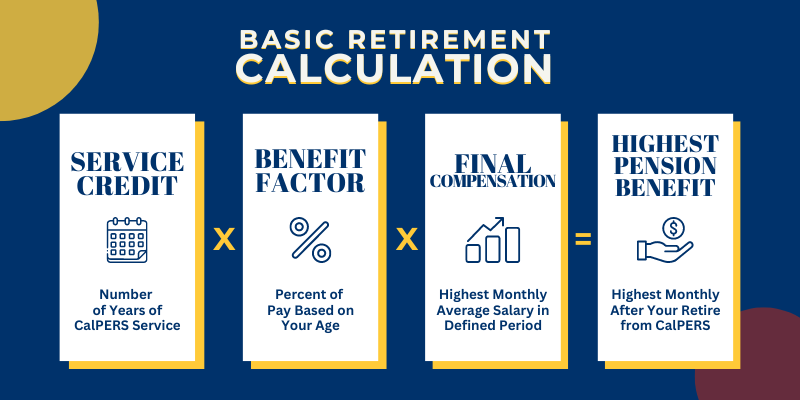
    The key to calculating your retirement benefit is to understand how service credit, age, and final compensation are used in the basic retirement calculation Increase any one of these factors and you’ll increase your overall benefit. The basic retirement calculation is shown below:

    Basic Retirement Calculation

    Service Credit

    Service credit is earned on a fiscal year basis, which is July 1 through June 30. If you are paid every month, 10 months of full-time employment will equal one year.

    You cannot earn more than one year of service credit in one fiscal year. If you work less than eight hours per day, it will take you longer to earn a year of service credit.

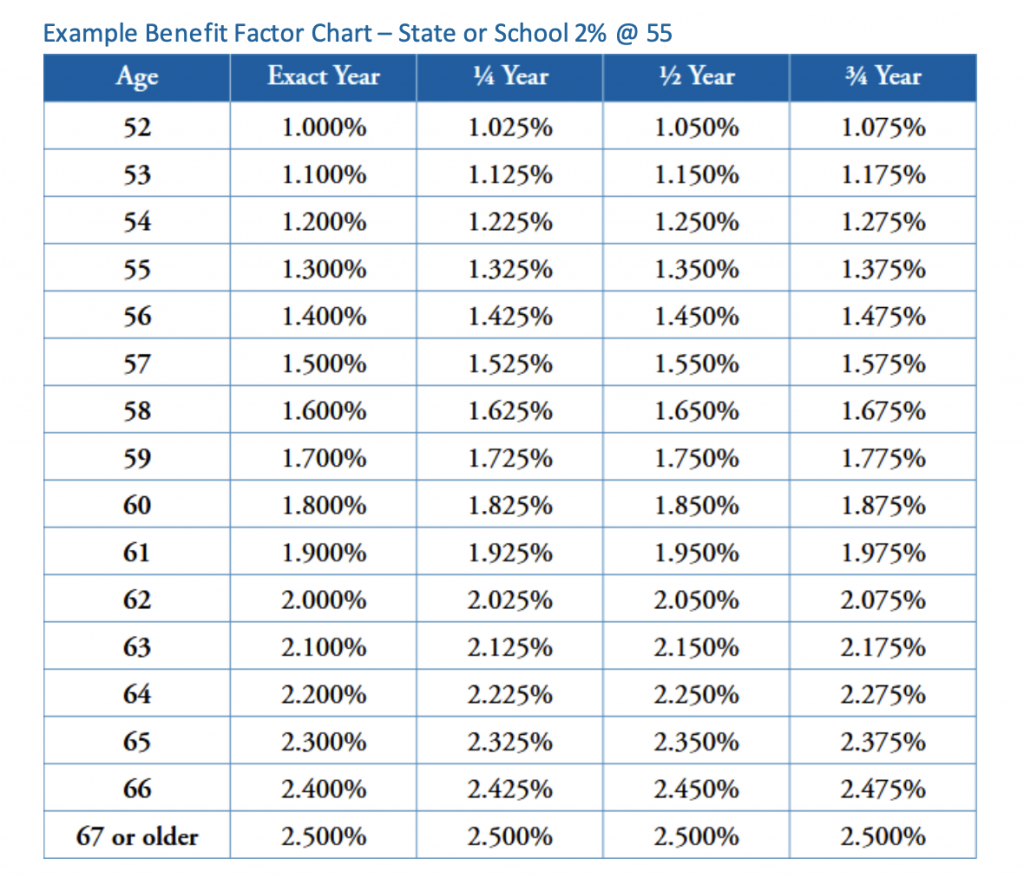
    Check the pdf file below to see a cheatsheet charts PDF file. It contains two charts that show the benefit factor increases and the percentage of final compensation you will receive.

    Benefit Factor

    Your benefit factor, also known as the “age factor,” is the percentage of pay you’ll receive for each year of service credit earned. It is determined by your retirement formula and age at retirement.

    Starting at your minimum retirement age, your benefit factor increases every quarter year up to a maximum age. For example, if your retirement formula is 2% at 55 and you retire at age 55, you will get 2% for each year of service credit. The percentage increases every quarter after age 55 up to the maximum age of 63.

    View Benefit Factor Charts Online


    Go to www.calpers.ca.gov/benefitcharts to find the retirement formula charts for your benefit factor and final compensation

    Benefit Factor Chart

    Retirement Planning Checklist


    As you plan for your retirement and get ready to submit your retirement
    application, use the following checklist as a reminder of what you need to
    consider You can find a detailed checklist with links to all our retirement
    planning resources at www.calpers.ca.gov/retirementchecklist

    In Conclusion


    As you can see, retirement planning might sound scary. Make sure you talk to your CSEA representative and ask for advice on the process. This article is just to show you an overview of the rights and tools that we as CSEA employees can utilize to fight for your rights.

  • Board Meeting: February 23, 2023

    Board Meeting: February 23, 2023

    Date: 02/23/2023

    Time: 05:00 PM

    Location: District Administrative Board Room

    Address: 901 Andrade Ave., Calexico, CA 92231